
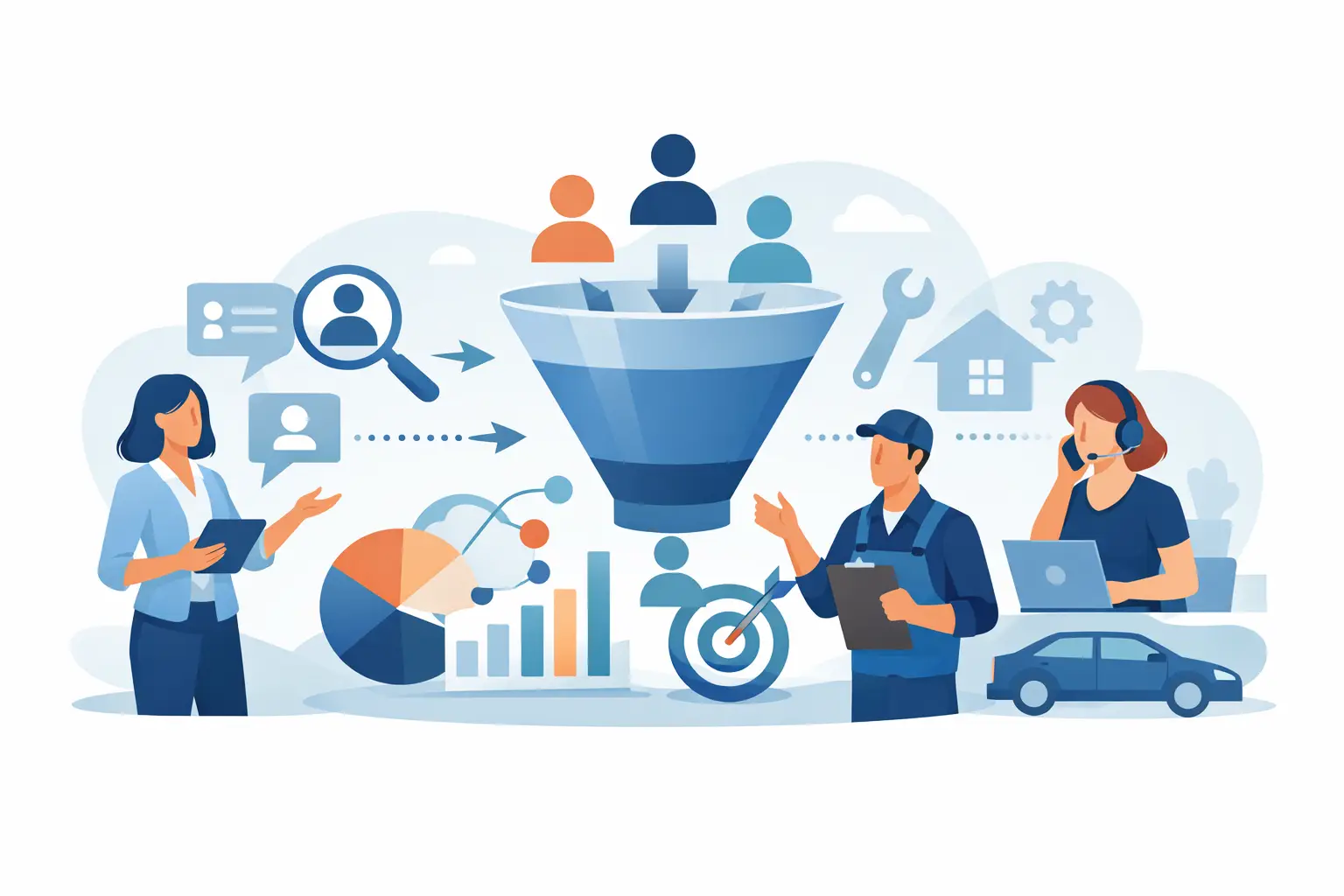
A lot of service businesses think they have a lead problem. They usually have an attribution problem first.
If you run a law firm, roofing company, med spa, HVAC business, or wealth management practice, you do not need prettier reports. You need to know which marketing dollars produced actual calls, booked appointments, signed jobs, and revenue. That is what lead attribution for service businesses is supposed to do. The problem is most setups are sloppy, incomplete, or built to make an agency look busy instead of making the business more money.
What lead attribution for service businesses actually means
Attribution is just the process of answering one blunt question: where did this lead come from?
Not where the visitor landed. Not which channel got credit inside a dashboard because it was easiest to measure. Not which vendor wants to protect their retainer. The real question is what source, campaign, keyword, referral, or touchpoint pushed a prospect to contact you.
For service businesses, that answer gets messy fast. Someone might find you through Google Business Profile, leave, read reviews later, click a branded search ad three days after that, and then call from their phone while sitting in a parking lot. If your tracking only credits the last click, you miss the bigger story. If your tracking only measures form fills, you miss the phone calls. If your front desk never asks how someone found you, you miss offline context too.
That is why attribution in service industries is harder than in ecommerce. There is no neat checkout trail. There are calls, repeat visits, spouse referrals, maps listings, voicemail leads, and sales cycles that can stretch for weeks.
Why most attribution setups fail
Most businesses are not failing because attribution is impossible. They are failing because the setup is half-finished.
The first problem is channel blindness. A lot of companies track web forms and ignore calls, text messages, live chat, direct bookings, and walk-ins. That creates fake certainty. You get a dashboard that says paid search generated five leads when the campaign actually drove fifteen phone calls and three booked consults.
The second problem is bad source labeling. Traffic gets dumped into buckets like direct, organic, referral, or paid with no real campaign discipline behind it. If your tagging is inconsistent, your reporting is fiction.
The third problem is the handoff between marketing and operations. A lead is not revenue. If your CRM is not connected, if call recordings are not reviewed, or if nobody marks whether a prospect became a customer, then you are measuring activity, not business impact.
Then there is the agency problem. Some vendors optimize for what they can claim, not what actually closes. They will happily take credit for branded search while ignoring the local SEO work, review strategy, search suggestion placement, or citation cleanup that created the demand in the first place. Attribution becomes politics.
The channels that matter most
Lead attribution for service businesses has to reflect how real customers behave, not how a reporting platform prefers to categorize them.
For most local and regional service companies, the channels that matter are organic search, Google Business Profile, paid search, local service ads where relevant, referrals, review platforms, social traffic, direct traffic, and offline sources. Calls matter just as much as forms, and in many industries they matter more. A personal injury lead, emergency plumbing call, or same-day dental inquiry is rarely taking the scenic route through a long conversion funnel.
That means your attribution model has to capture call tracking, form tracking, booking requests, chat submissions, and CRM outcomes together. If one of those pieces is missing, you are making budget decisions with partial data.
First-click, last-click, and multi-touch - what actually helps?
This is where a lot of marketing content gets cute. It should not.
Last-click attribution is useful because it tells you what finally converted the lead. For service businesses, that matters. If someone clicked a branded ad and called, that final action deserves attention.
First-click attribution is also useful because it shows which channel introduced the prospect. That matters too, especially if your SEO, maps visibility, or early-stage search presence is creating demand that paid search later captures.
Multi-touch attribution is the better long-term view because it reflects reality. Buyers often need several interactions before they trust a service business enough to call. But multi-touch only helps if your tracking is clean and your team can actually use the data. If your setup is a mess, a fancy attribution model just gives you more complicated nonsense.
For most businesses, the practical move is simple: look at first touch, last touch, and closed revenue together. That gives you enough clarity to stop wasting money without overengineering the system.
How to build lead attribution for service businesses that is actually usable
Start with the conversion points. Track every form, every tracked phone call, every booking action, and every meaningful chat interaction. If your business closes deals over the phone, call tracking is not optional.
Next, clean up your source tracking. Every paid campaign needs disciplined UTM tagging. Every landing page should connect to the right campaign and source. If your CRM accepts source data, push it in automatically instead of relying on manual notes.
Then connect lead data to sales outcomes. This is where most companies get lazy. A lead that never answers the phone is not equal to a qualified consultation. A consultation is not equal to a signed project. If you want real attribution, your CRM needs status stages that reflect your pipeline.
After that, review call quality. Not every call is a lead. Some are spam, vendor calls, existing customers, or wrong numbers. If you count everything as a conversion, your reporting inflates performance and your optimization gets worse.
Finally, force operational discipline. Whoever answers the phone or reviews inbound inquiries should still ask how the prospect heard about you. Yes, people forget. Yes, answers can be messy. It is still valuable. Attribution is strongest when digital tracking and human intake support each other.
What good attribution changes in the real world
Once attribution is reliable, a lot of bad decisions die fast.
You stop overfunding channels that create cheap but weak leads. You spot the campaigns generating high-value jobs instead of just high lead counts. You see whether organic search is driving first-touch discovery while paid search closes bottom-funnel demand. You find out whether your Google Business Profile is carrying more weight than your agency admitted.
You also get better at speed. If one service line, geography, or keyword cluster starts producing qualified calls, you can press harder there immediately. If another campaign looks active but never turns into revenue, you cut it before another quarter gets burned.
That is the difference between reporting and control.
The trade-offs nobody likes to admit
Attribution is never perfect. Anyone promising perfect attribution is selling theater.
Some prospects switch devices. Some call from a number that cannot be matched cleanly. Some hear about you from a referral and then search your brand later. Some see your truck, read your reviews, and finally click an ad. Real buying behavior is not tidy.
There is also a privacy trade-off. The more aggressive your tracking, the more careful you need to be about compliance, consent, and platform limits. Depending on your industry, especially legal or medical, the setup has to respect regulatory boundaries.
And there is a cost trade-off. Better attribution usually requires better tools, better process, and tighter CRM management. That is worth it when a new client is worth thousands or tens of thousands of dollars. It may be overkill if your average ticket is low and your sales cycle is simple. It depends on lead value, sales complexity, and how fast you need to make spending decisions.
What service business owners should demand from marketing partners
If you are paying for growth, you should not accept fuzzy attribution.
Ask how calls are tracked. Ask whether form fills are tied to campaign sources. Ask whether closed revenue can be connected back to channel and campaign. Ask how branded search is separated from non-branded search. Ask how they validate lead quality instead of just counting conversions.
Most of all, ask what happens when the data shows a favorite channel is underperforming. A real performance partner adjusts. A weak agency deflects, changes the reporting window, or hides behind vanity metrics.
This is one of the reasons businesses move toward firms like Mostly Marketing. Owners are tired of hearing that everything is working while the phone says otherwise. They want proof, not interpretation.
The standard that actually matters
Lead attribution for service businesses is not about building a prettier dashboard. It is about creating enough clarity to make hard decisions with confidence.
When you know where qualified leads start, where they convert, and which ones turn into revenue, your marketing gets sharper. Your budget gets cleaner. Your patience for vague agency talk disappears.
That is a good thing. If the goal is growth, every channel should earn its keep.
Share this article
The featured image previews automatically when this link is shared.