
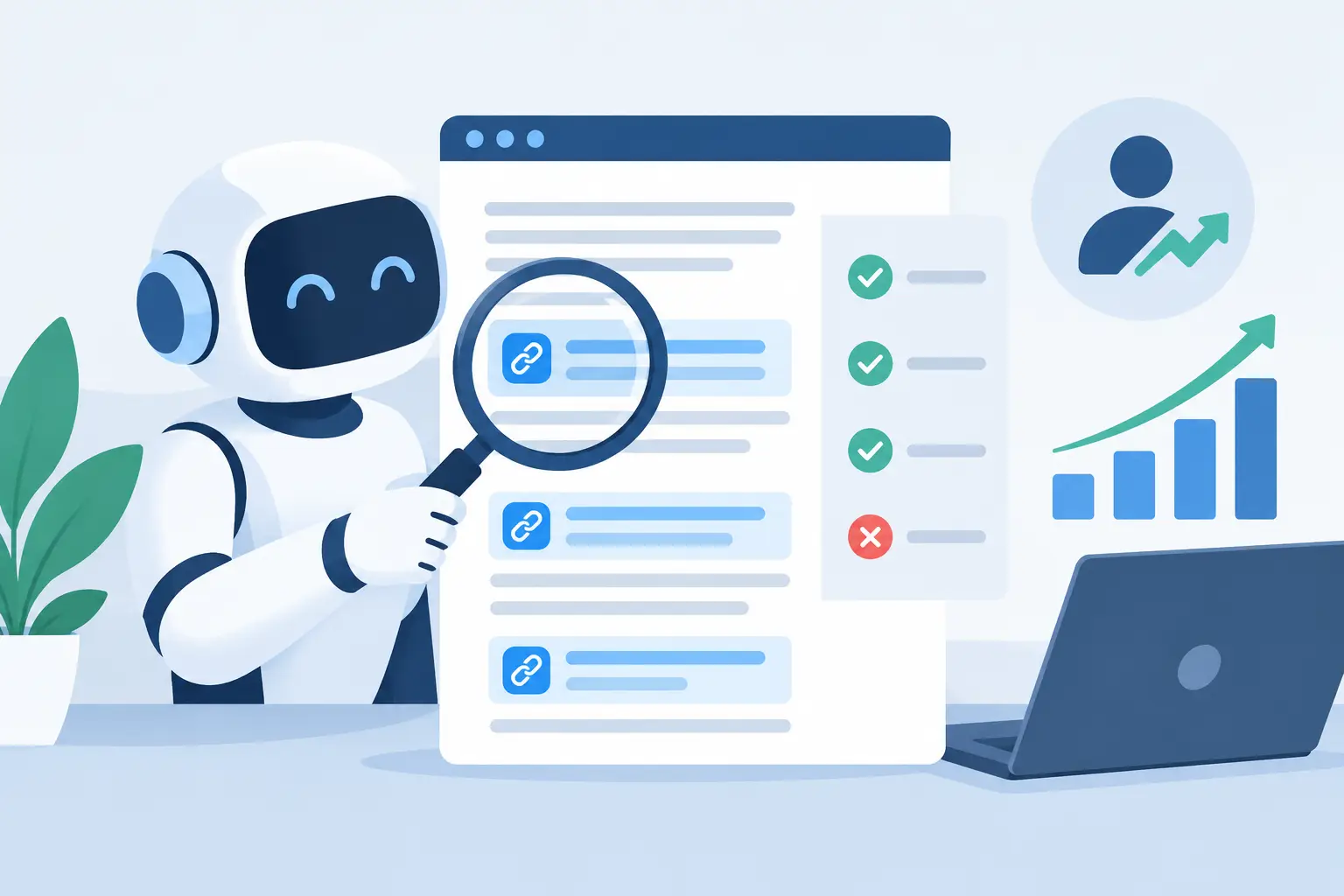
A homeowner asks an AI assistant for the best emergency plumber nearby. A prospective client asks which personal injury firm handles truck accidents in your county. The answer may include your business, a competitor, or nobody at all. If the details are wrong, you do not just lose a ranking. You lose the call before the buyer ever reaches your website.
That is why you need to audit AI citations. This is not another vanity-report exercise. It is a direct check on whether answer engines can identify, trust, and accurately recommend your business when high-intent customers ask for help.
Traditional local SEO taught business owners to watch maps, rankings, reviews, and directory listings. Those still matter. But AI-driven search adds another layer: systems now synthesize answers from your website, business profiles, reviews, directories, industry publications, and third-party data. If those sources conflict, the AI may hedge, repeat bad information, or recommend the competitor with cleaner evidence.
What an AI Citation Audit Actually Checks
An AI citation is any source that helps an answer engine verify or describe your company. It can be a local listing, a review platform profile, a chamber directory, a trade association page, a service-area page, a news mention, or a well-structured page on your own site.
The problem is that answer engines do not treat every source equally. They look for consistency, specificity, freshness, and signs that a real business can back up what it claims. A generic directory listing with the correct phone number helps less than a detailed, current source that confirms your services, location, credentials, and reputation.
A real audit asks harder questions than, “Are we listed online?” It asks:
- Can an AI tool find the correct name, address, phone number, website, and business category?
- Does it understand your actual service area, not just the city in your mailing address?
- Can it verify your most profitable services and specialties?
- Are old addresses, former phone numbers, duplicate listings, or outdated service descriptions creating confusion?
- Does the web provide enough third-party proof to support a recommendation?
That distinction matters. A business can have 80 citations and still be invisible in AI answers if the information is thin, inconsistent, or disconnected from buyer intent.
Why Bad AI Citations Cost Real Revenue
For local service businesses, search visibility has always been a trust game. AI answers make the trust filter tighter because the system is expected to give users a useful recommendation, not a page of blue links.
If your law firm is described as a general practice while competitors are consistently identified as truck accident attorneys, who gets surfaced for a truck accident query? If your landscaping company serves five affluent suburbs but citations only mention one city, who gets suggested when a homeowner asks for a landscape designer in the other four?
The answer is usually not the company with the best work. It is the company whose digital footprint gives the machine fewer reasons to doubt it.
There is a trade-off here. Chasing every low-quality directory is a waste of time and can create more cleanup work. The goal is not citation volume for its own sake. The goal is a defensible set of accurate, relevant signals that explain who you are, where you work, and why customers should choose you.
How to Audit AI Citations in 6 Steps
1. Start with the revenue questions customers ask
Do not start with your brand name. Start with the questions that produce calls, consultations, and booked jobs.
A roofing contractor might test prompts such as “best hail damage roof repair company in [city]” or “who installs metal roofs near [suburb].” A medical practice might test “top-rated sports medicine doctor for knee pain in [city].” A financial advisor might test “fiduciary retirement planning advisor near me.”
Run variations through the major answer environments your customers use, including AI search features, conversational AI tools, and voice assistants. Record whether you appear, how you are described, which competitors appear, and what sources are visibly referenced when available.
Do not overreact to one answer. Results can vary by platform, location, personalization, and prompt wording. Look for patterns across multiple high-value questions.
2. Verify your core business identity everywhere
Your business name, address, phone number, website, hours, and primary category need to agree across the sources that matter. This sounds basic because it is basic. It is also where lazy agencies and rushed business owners leave expensive mistakes sitting for years.
Pay special attention to old suite numbers, tracking numbers that replaced your main number, rebrands, acquisitions, previous URLs, and duplicate profiles. These are not harmless leftovers. They can split authority and give answer engines conflicting records to reconcile.
For service-area businesses, be precise. Do not pretend you have offices where you do not. Instead, make the service areas clear through legitimate profiles, service pages, project evidence, reviews, and local mentions.
3. Check whether your services are described with buyer language
AI cannot confidently recommend what it cannot clearly categorize. “Quality service” and “solutions for every need” are agency filler, not evidence.
Your website and authoritative citations should state the services customers search for. A construction company should distinguish kitchen remodeling from whole-home renovations, commercial build-outs, or historic restoration. A law firm should distinguish estate planning from probate litigation. A dentist should distinguish emergency care, implants, and Invisalign.
Be specific without making claims you cannot substantiate. Overstating specialties might create short-term keyword coverage, but it weakens trust and creates operational problems when the calls are wrong.
4. Audit third-party proof, not just directories
This is where many local businesses fall behind. An answer engine has more confidence when independent sources corroborate your business.
Look for reviews that mention specific services and locations, professional licensing records, trade association profiles, local media coverage, manufacturer or partner directories, sponsorships, awards with real criteria, and case studies or project features. You do not need to manufacture publicity. You need credible proof that your business exists, performs the work, and serves the market you claim.
Review quality matters more than a star average alone. A steady flow of detailed, authentic reviews gives both customers and machines context. A pile of vague five-star ratings does far less to explain why you are the right recommendation.
5. Compare your citation footprint with the businesses AI recommends
When a competitor repeatedly shows up, inspect the evidence trail. Are they present in stronger industry directories? Do their location pages answer common questions better? Do reviews consistently reinforce a niche service? Have they earned mentions from local organizations?
This is not about copying their website line by line. It is about finding the missing proof in your own market presence. Sometimes the gap is technical. Sometimes it is a category mismatch. Often, it is simply that the competitor has made their expertise easier to verify.
A useful audit separates fixes into three buckets: errors that must be corrected immediately, gaps that block high-value recommendations, and lower-priority opportunities that can wait. That prevents your team from spending months polishing listings that have no bearing on revenue.
6. Fix, document, and retest
Correct the primary data sources first, then work outward to influential directories and industry-specific profiles. Update your own website so the same facts appear in clear language, especially on location, service, contact, and about pages.
Keep a simple change log with the source, issue, correction date, and verification status. This is not bureaucracy. It gives you a way to identify what changed when visibility improves or drops.
Then retest the original revenue questions. AI visibility is not a one-time project because business information changes, platforms refresh data at different speeds, and competitors keep building their own proof. Quarterly audits are reasonable for most established local businesses. Monthly monitoring makes sense in highly competitive markets or after a move, rebrand, merger, or service expansion.
The Metrics That Matter After an AI Citation Audit
Do not let anyone sell you a report full of citation counts and call it progress. Track whether your corrected footprint changes business outcomes.
Watch branded search trends, non-branded local visibility for priority services, qualified phone calls, form submissions, booked consultations, and the quality of leads from each target market. Ask new customers how they found you, and give your front desk a short list of answer-engine referrals to listen for. Attribution will never be perfect, but “we fixed 43 listings” is not a revenue metric.
The strongest signal is simple: are more qualified prospects finding accurate information and choosing to contact you? If the answer is no, the strategy needs adjustment.
Stop Letting Old Data Choose Your Competitors
AI search rewards businesses that make trust easy to verify. That does not mean you need a massive marketing budget or another bloated agency retainer. It means your business facts, service expertise, and third-party proof need to tell one consistent story.
Mostly Marketing treats that story like a lead-generation asset, not a directory cleanup chore. Start with the searches that drive revenue, find the evidence gaps, fix what is costing you visibility, and keep testing. The next customer asking AI for a recommendation should get the right answer.
Share this article
The featured image previews automatically when this link is shared.