
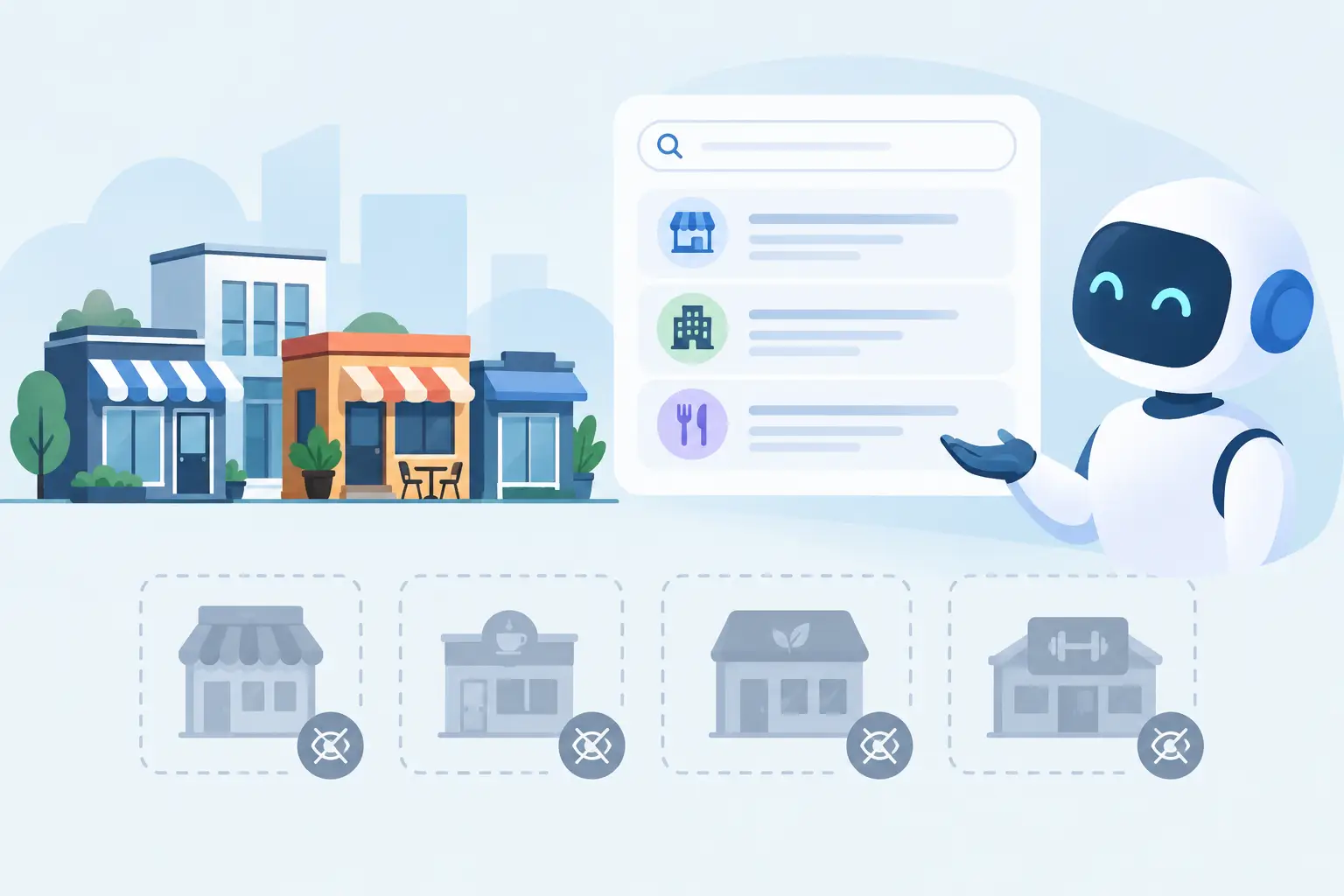
A homeowner asks an AI assistant for the best foundation repair company nearby. A prospective client asks which estate planning attorney handles complex trusts. The answer names three competitors and skips your business entirely.
That is not a branding problem. It is a pipeline problem. Understanding why AI answers omit businesses is now part of protecting your inbound lead flow, especially if your company depends on local, high-intent searches that turn into calls, estimates, and booked consultations.
AI answer engines do not operate like a yellow pages directory. They are trying to produce one confident, defensible response from a messy web. If your business is hard to verify, poorly defined, inconsistently cited, or invisible in the sources these systems trust, you can be excellent at your work and still never make the answer.
AI Does Not Omit Businesses at Random
Most business owners assume the company with the best website wins. That was never fully true in traditional search, and it is even less true in AI-generated answers.
Answer engines have to decide whether a business is relevant, legitimate, and specific enough to recommend. They pull signals from business profiles, directories, review platforms, maps, trade publications, local news, websites, third-party mentions, and structured data. Then they compress those signals into an answer that sounds certain.
If the evidence is weak or contradictory, AI often takes the safer route: it mentions the businesses it can identify with confidence and leaves everyone else out.
That creates a brutal reality for local service companies. Being good is not the same as being machine-verifiable. A five-star contractor with scattered citations and a vague website can lose visibility to a less capable competitor whose business information is consistent everywhere.
The 5 Reasons AI Answers Omit Businesses
1. Your business entity is unclear
An entity is not just your company name. It is the complete, consistent digital identity of your business: name, address, phone number, service area, category, ownership, specialties, credentials, reviews, and relationships to trusted sources.
If one directory calls you “Smith Home Services,” your Google profile says “Smith HVAC & Plumbing,” and your website uses “Smith Mechanical,” you have created unnecessary ambiguity. A person may understand that those are the same company. A system trying to avoid a bad recommendation may not.
The same problem appears when a business changes addresses, uses multiple tracking numbers without clear attribution, or has duplicate profiles floating around the web. These are not minor cleanup tasks. They are trust leaks.
2. Your website is broad when the question is specific
AI answers are built around intent. Someone searching “best roofer” may get a different answer than someone asking, “Who installs standing seam metal roofs after storm damage in Plano?”
A generic services page that says you provide “quality roofing solutions” gives an answer engine almost nothing useful to work with. It does not prove which roofing services you perform, who you serve, where you operate, what problems you solve, or why your company is a credible fit.
Specificity wins because it reduces uncertainty. Service pages should clearly explain the job, the location, the customer type, the process, and relevant proof. Not stuffed keywords. Evidence.
A medical practice should not only say it provides orthopedic care. It should accurately define conditions treated, procedures offered, provider credentials, locations, insurance considerations where appropriate, and patient-facing next steps. A law firm should not hide its practice focus behind legal jargon. If you handle business litigation, commercial leases, or trust administration, say so plainly.
3. You have reviews, but no meaningful review signal
Review count alone does not make a business recommendation-worthy. AI systems and the platforms feeding them can detect patterns: recency, detail, consistency, category relevance, sentiment, and whether reviews describe the service a prospect is asking about.
Twenty short reviews saying “Great job!” are better than nothing. They are not as useful as consistent, authentic feedback that mentions the actual work: emergency water damage cleanup, dental implants, commercial landscape design, custody representation, or kitchen remodel project management.
Do not script reviews or manufacture them. That is a shortcut to reputational damage and platform problems. Build a process that asks real customers at the right moment, makes leaving feedback easy, and responds professionally to both praise and criticism.
4. Third-party sources do not validate your claims
Your website can say you are the top provider in town all day. An answer engine has little reason to repeat that claim unless other credible sources support the underlying facts.
This is where citations, industry listings, local associations, supplier partnerships, professional credentials, media mentions, and accurate profiles matter. They help establish that your company exists, operates where it says it does, and performs the services it claims.
There is a trade-off here. Chasing every low-quality directory is wasted motion. What matters is coverage across reputable, relevant sources and complete consistency in the information published there. A financial advisor needs different validation sources than a landscape contractor. A regional hospitality group needs different signals than a personal injury firm.
The goal is not to spray your name across the internet. The goal is to create a clean evidence trail.
5. Your competitors have built stronger topical proof
AI frequently favors businesses that appear repeatedly in context around a subject. That does not mean publishing 100 thin blog posts written for robots. It means earning and creating useful content that demonstrates legitimate expertise.
For a home services company, that could mean clear service pages, project examples, FAQs based on real customer questions, technician qualifications, and local guidance tied to actual service areas. For a law firm, it could mean accurate explanations of case types, attorney bios, public records of professional standing, and content that answers the questions clients ask before they call.
A competitor that is consistently associated with a service category is easier for an answer engine to select. If your digital presence is mostly a homepage and a contact form, the system has very little to work with.
What to Fix Before You Spend More on Ads
Paid traffic can still produce leads. But buying clicks while your business is poorly represented across search, maps, and answer engines is like pouring water into a bucket with a crack in it. You may get results, but you will pay more than you should and remain dependent on every next dollar of ad spend.
Start with a visibility audit that answers hard questions. Is your business information consistent across major sources? Are duplicate listings confusing the market? Can a customer and an AI system quickly understand your primary services and service areas? Do your reviews reinforce your highest-value offerings? Are your credentials, team members, and local relevance visible and accurate?
Then prioritize fixes by revenue impact. A plumber does not need a content library about every plumbing topic before correcting an incorrect phone number, claiming neglected profiles, improving service-page clarity, and building a review process. A multi-location dental group may need location-level entity cleanup before creating more educational articles.
This is where traditional agency packages fail business owners. They sell a fixed checklist, send a monthly report full of vanity metrics, and call it strategy. Your visibility problems are not identical to the business down the street. The work should adapt to the evidence gap that is costing you leads.
How to Become Easier for AI to Recommend
The best approach is simple, even if the execution requires discipline. Make it easy for machines to verify what customers already need to know.
Your business name, contact details, locations, categories, hours, and service areas should match across the web. Your site should explain your services in direct language and connect each service to the right market. Your people, qualifications, and proof should be visible. Your review strategy should produce honest, detailed feedback over time. And your third-party footprint should support your claims rather than contradict them.
Do not expect an overnight switch. Answer engines change sources, models, and response formats constantly. Some queries will name businesses. Others will provide general advice or cite directories instead of individual providers. That is why the objective is not gaming one chatbot prompt. It is becoming the clearest, most credible answer across the search ecosystem.
Mostly Marketing approaches this the way operators expect it to be handled: find the leaks, fix the evidence, measure the movement, and scale what produces qualified traffic. No bloated retainer required to discover whether the work can move the needle.
Your next customer may never scroll past a list of ten blue links. Make sure the systems answering their question have enough proof to include you.
Share this article
The featured image previews automatically when this link is shared.