
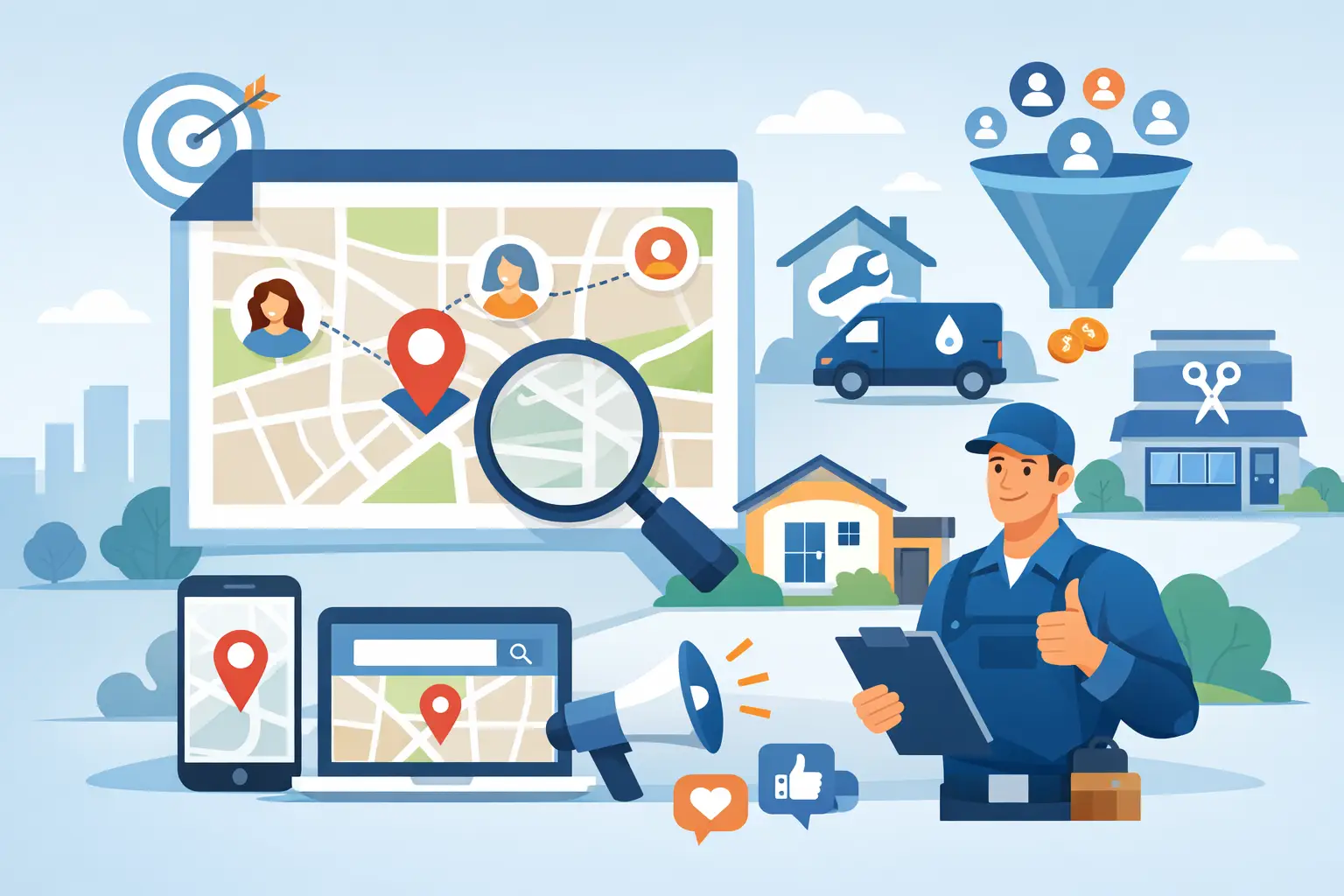
Most local businesses do not have a traffic problem. They have a conversion problem, a visibility problem, or an attribution problem. This local lead generation guide is built for owners who are tired of paying for activity that never turns into booked jobs, qualified calls, or signed contracts.
If that sounds familiar, good. That means you are looking at the right issue. Local lead generation is not about spraying your name across the internet and hoping somebody bites. It is about showing up when high-intent buyers search, giving them a reason to trust you fast, and making it painfully easy to contact you.
What local lead generation actually means
For a service business, local lead generation means creating a predictable flow of nearby prospects who are ready to call, book, request a quote, or schedule a consultation. Not random website visitors. Not vanity traffic from the other side of the country. Not inflated reports full of impressions and clicks that never become revenue.
That distinction matters because a lot of agencies still sell the wrong thing. They pitch broad awareness when what you need is demand capture. They talk reach while your calendar has holes in it. If you run a law firm, HVAC company, med spa, roofing company, dental office, or financial practice, the metric that matters is simple: are qualified local buyers contacting you at a profitable rate?
The local lead generation guide starts with intent
The highest-value local leads usually come from search behavior, not interruption marketing. Someone searching for "emergency plumber near me" or "estate planning attorney in Dallas" is not browsing for entertainment. They have a problem and they want a solution now.
That is why local search is such a brutal advantage when it is handled correctly. You are not trying to convince an uninterested audience to care. You are stepping in front of people who already care. Your job is to win the click, win the trust, and win the inquiry.
There is a trade-off here. Search-driven lead generation usually takes stronger operational discipline than broad paid campaigns. Your business listing has to be accurate. Your site has to load fast. Your pages have to match search intent. Your reviews need to look real and recent. If any of that breaks, the lead flow weakens.
The five parts of a local lead system that works
1. Search visibility where buyers are actually looking
If your business is buried in local map results or absent from organic search for core service terms, you are invisible when it counts. Local lead generation starts with getting found for the searches that signal action.
That means your Google Business Profile cannot be half-finished. Your categories, service descriptions, hours, photos, and service areas need to be accurate and actively maintained. It also means your website should not be a generic brochure. Each priority service and key location needs dedicated content built around what people actually search.
Too many businesses lump everything onto one page and wonder why they do not rank. Google does not guess what you meant. It responds to clear relevance.
2. Trust signals that remove hesitation
A local buyer makes fast judgments. In seconds, they are asking themselves whether you look legitimate, whether you serve their area, whether you solve their problem, and whether contacting you will waste their time.
This is where reviews, before-and-after proof, clear service explanations, licensing information, and visible contact details carry real weight. The best-performing local brands do not hide behind vague claims. They show proof. They answer obvious objections. They make the next step feel safe.
If you have weak reviews or stale reviews, fix that. A business with great rankings and thin credibility still leaks leads.
3. Conversion paths that do not fight the user
Here is where many campaigns die. The traffic shows up, but the site asks people to work too hard. The phone number is buried. The form is long. The page is slow. The message is vague. The buyer leaves.
Your local lead system should give prospects multiple easy ways to convert. Calls matter. Short forms matter. Booking options matter when relevant. Messaging should be direct and local. If you serve homeowners in specific cities, say so clearly. If you offer emergency response, financing, same-day scheduling, or free estimates, put that where buyers can see it.
There is no prize for making people hunt for the obvious.
4. Tracking that tells the truth
If you cannot trace leads back to source, you are guessing. Guessing is how businesses keep funding losing channels while cutting the ones that were quietly working.
A serious local lead generation guide has to include call tracking, form tracking, source attribution, and basic lead quality review. Not every call is good. Not every form fill is sales-ready. If your reporting does not separate junk from opportunity, it is not reporting. It is decoration.
This is one of the biggest reasons business owners get burned by agencies. They get glossy dashboards and no operational truth. What you want is a clear line between search visibility, lead volume, lead quality, and closed revenue.
5. Ongoing optimization instead of set-it-and-forget-it nonsense
Local markets shift. Competitors improve. Search behavior changes. Reviews come in. Rankings move. Paid costs rise. A lead system that worked six months ago can quietly underperform today.
That does not mean you need constant reinvention. It means you need active management. Small improvements in page structure, listings accuracy, review velocity, search query targeting, and conversion flow can create outsized gains. The businesses that keep winning locally are rarely the flashiest. They are the most consistent.
Where most local lead generation guides get it wrong
A lot of advice in this space is technically correct and commercially useless. It tells you to "post more content" or "be active on social" without asking whether those actions produce qualified demand in your market.
For local service businesses, not every channel deserves equal attention. Social media can help credibility, but for many businesses it is a supporting asset, not the engine. Paid ads can work, but they become expensive fast if your conversion path is weak or your targeting is loose. SEO is powerful, but not if you treat it like a six-month black box with no accountability.
The right mix depends on your sales cycle, deal value, competition, and geography. A personal injury firm in a major metro should not use the same lead strategy as a local landscaping company in a suburban market. One has high customer value and brutal competition. The other may win big by dominating maps, reviews, and city-specific service pages.
That is why one-size-fits-all retainers are usually a bad sign. If the agency sells the same package to everybody, they are optimizing their process, not your growth.
How to prioritize if your budget is tight
If you are not ready for an aggressive multi-channel rollout, start where intent is strongest and waste is easiest to cut.
First, fix your local presence. Clean up your business profile, citations, service pages, and review process. Second, improve conversion basics on your site so existing traffic produces more calls and forms. Third, track everything before increasing spend. Only after that should you layer in paid campaigns or broader content expansion.
This order is not glamorous, but it works. You do not scale chaos. You tighten the machine, then feed it more demand.
For skeptical owners, that matters. You should not need blind faith to buy marketing. A smart partner proves movement early, shows you where leads came from, and earns the next phase by performance. That is the difference between strategy and sales talk.
A better standard for local growth
The businesses pulling ahead right now are not necessarily spending the most. They are just harder to beat because they are visible earlier, trusted faster, and measured more honestly. They know which searches matter. They know which pages convert. They know which calls turned into revenue.
That is the real point of a local lead generation guide. Not to give you another stack of marketing tasks, but to force clarity. Where are buyers finding you? Why are they choosing you? Where are leads being lost? What can be measured today instead of promised later?
Mostly Marketing was built around that standard because too many local businesses have already paid tuition to agencies that talked big and proved nothing. If your lead generation depends on hope, vague reporting, or bloated retainers, it is not a growth system. It is overhead.
Start with visibility. Tighten trust. Remove friction. Track the truth. Then scale what earns its keep. Local buyers are already searching. The question is whether your business shows up ready to win.
Share this article
The featured image previews automatically when this link is shared.