A prospect calls your office and says, “ChatGPT recommended you.” Your receptionist logs the call as a referral, your CRM tags it as direct traffic, and the agency report claims Google organic drove the lead. Everyone has a story. Nobody has proof. AI search attribution is how you stop letting that confusion decide where your marketing budget goes.
For local service businesses, this is not a vanity reporting issue. It is a revenue issue. If an AI answer engine puts your firm, practice, or company in front of a buyer researching a costly decision, that visibility can create a call days or weeks later. The old last-click model is too blunt to explain what happened. It rewards the final touchpoint and ignores the work that made you credible enough to be considered.
That does not mean you should accept vague claims that “AI is working.” It means you need a better measurement system - one tied to qualified leads, booked appointments, and closed revenue.
What AI Search Attribution Actually Measures
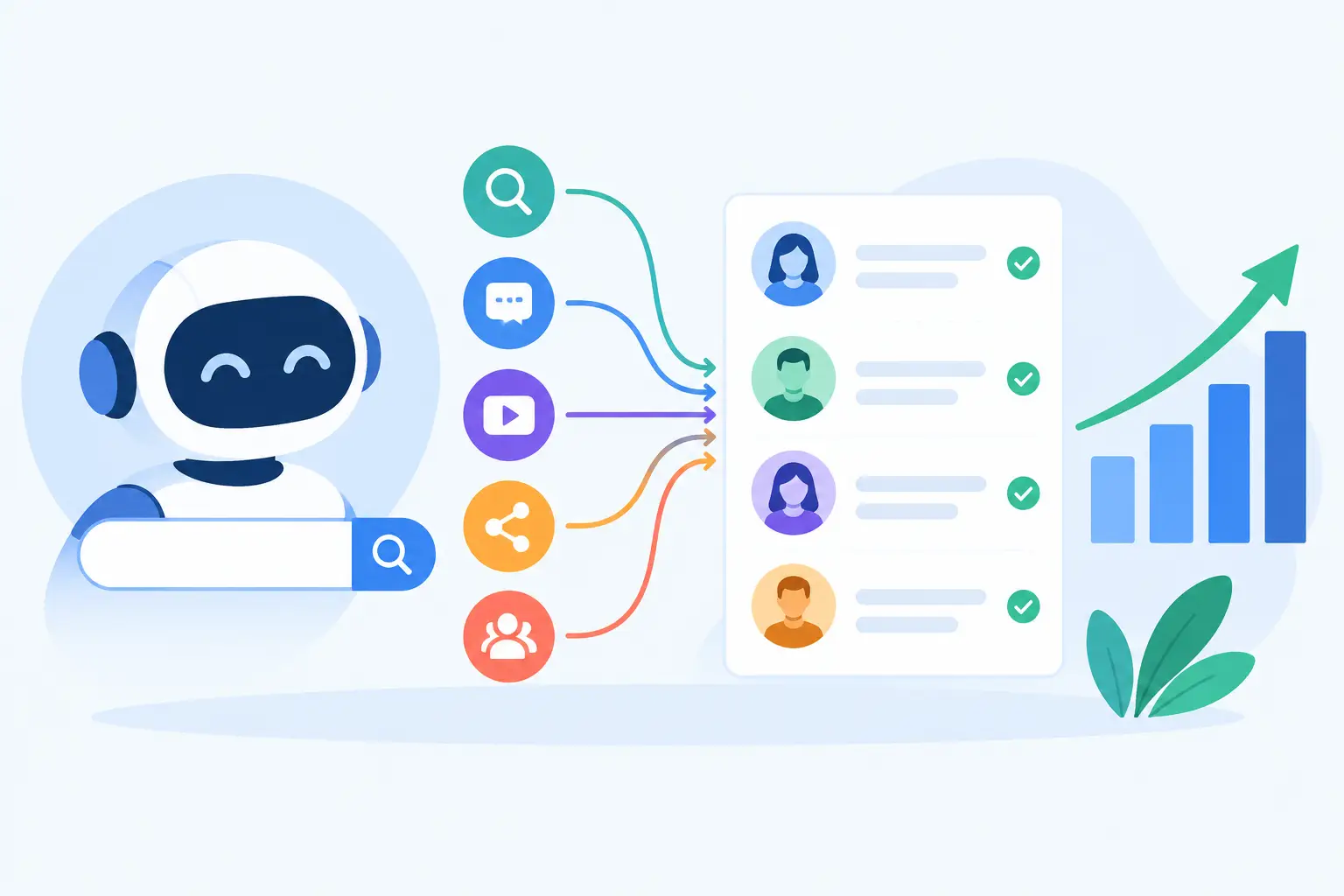
AI search attribution connects a lead back to the search visibility and marketing actions that influenced it. That may include a mention in an AI-generated answer, a branded search after an AI recommendation, an entity citation, a review profile, a comparison page, or a search suggestion that introduced your business before the prospect ever visited your site.
Traditional analytics is built around trackable clicks. A person searches Google, clicks an ad or organic result, lands on a page, and converts. Clean enough, at least in theory.
AI-assisted discovery is messier. A buyer might ask an answer engine for the best estate planning attorney in their city, receive several names, search one of those names later, read reviews, visit the website from a mobile device, then call from a different phone. Your analytics platform may label that final visit as direct, organic, or branded search. None of those labels tell the full story.
The goal is not to pretend every interaction can be tracked perfectly. It cannot. The goal is to reduce blind spots enough to make better investment decisions than your competitors and your last agency.
Why Last-Click Reporting Fails Service Businesses
Last-click attribution gives all credit to the final measurable action before a conversion. That is convenient for dashboards. It is terrible for understanding high-consideration service purchases.
A roofing customer may see your business in an AI answer, compare two companies, ask a neighbor, search your name, and submit a form three days later. If your report credits only organic branded search, you may conclude that generic visibility, reviews, citations, and answer-engine presence do not matter. Then you cut the very work feeding your branded demand.
The opposite mistake is just as expensive. Some agencies will point to rising impressions, AI mentions, or referral traffic and declare victory while your calendar stays empty. Visibility without commercial action is not performance. A local business does not pay its staff with impressions.
Real attribution has to answer two questions: what introduced the prospect to your business, and what converted them into a real opportunity? Those are often different channels, and both matter.
Attribution is evidence, not magic
No honest marketer can identify every AI-influenced lead with absolute certainty. Answer engines do not expose complete user journeys, and many buyers move between devices, browsers, calls, and offline conversations.
That is not an excuse to give up. It is a reason to use multiple forms of evidence instead of one convenient metric. When source data, lead responses, branded-search growth, call recordings, landing-page behavior, and closed revenue point in the same direction, you have a defensible signal. When they conflict, investigate before spending more.
Build AI Search Attribution Around Revenue
Start with the outcome that matters. For a law firm, that may be qualified consultations that retain. For an HVAC company, it may be booked estimates that turn into profitable jobs. For a medical practice, it may be scheduled new-patient visits that actually show up.
Do not let a marketing vendor define success as traffic because traffic is easy to inflate. Define the funnel from first inquiry through sale, then make every stage visible.
1. Capture source information at the moment of contact
Your intake process needs a direct question: “How did you first hear about us?” Give staff a simple set of choices, including AI tools and answer engines, Google search, referral, social media, review sites, and other. Then leave room for the prospect’s actual words.
Do not bury this in a form no one completes. Train the person answering calls to ask it naturally and record the answer in the CRM. Call recordings are especially useful because they expose details a dropdown menu misses, such as “I asked ChatGPT who handles commercial lease disputes around here.”
Self-reported attribution is imperfect. People forget, simplify, and sometimes call every online discovery “Google.” But it is still valuable evidence, particularly when it is collected consistently rather than occasionally.
2. Separate discovery from conversion
A lead can discover you through an AI answer and convert through a branded Google search, a map listing, or a direct call. Track both fields in your CRM: first known discovery source and conversion source.
This distinction prevents bad decisions. If branded searches rise after your entity citations, review strategy, answer-focused content, and search visibility work improve, that is not random noise. It may show that more buyers are encountering your name before they search for it directly.
You should also track the conversion asset. Was it a service page, location page, booking page, call extension, or review profile that got the lead over the line? Discovery gets attention. Conversion assets get fixed when they leak money.
3. Use clean tracking where tracking is possible
Every campaign, landing page, form, and call path should feed into a system you can audit. Use distinct phone numbers or dynamic call tracking where appropriate, preserve source details in form submissions, and make sure online appointments carry their source data into the CRM.
There is a trade-off here. Overcomplicated tracking can create privacy concerns, break site performance, or leave your team drowning in dashboards. The answer is not to track everything. Track the actions that connect visibility to revenue: calls, forms, booked appointments, qualified opportunities, and sales.
If your business uses multiple locations, service lines, or sales teams, enforce consistent lead statuses. A “lead” should not mean a spam form, a job seeker, and a $20,000 commercial inquiry all at once. Bad CRM hygiene destroys attribution faster than any AI platform changes its interface.
4. Measure assisted signals, not just direct referrals
Direct referrals from AI platforms may appear in analytics, but relying on them alone will undercount influence. Many prospects will not click a cited source. They will copy your name, search later, or ask a follow-up question in another channel.
Look for directional evidence over comparable periods: growth in branded searches, increases in named requests on calls, more prospects referencing AI tools during intake, higher conversion rates on pages frequently surfaced for answer-oriented queries, and stronger lead volume in services where your visibility has improved.
Context matters. Seasonality, ad spend, local demand, staffing changes, and competitor activity can all affect those numbers. That is why smart attribution compares several indicators instead of crowning one chart the truth.
5. Close the loop with revenue, not leads
A campaign that creates 50 low-quality inquiries is not better than one that creates 10 retainers, procedures, or high-margin jobs. Push closed revenue back into your reporting whenever possible.
Review performance by source, service, location, and lead quality. If AI-influenced leads are fewer but close at a higher rate, they may be worth more than a larger volume of cheap clicks. If they produce curiosity but no bookings, your positioning, intake process, or offer may need work.
This is where most agency reporting falls apart. They report the top of the funnel because they do not have access to the bottom. A serious growth partner asks for the sales outcome, even when the answer is uncomfortable.
What to Ask Before You Fund More AI Visibility
Before you invest heavily in answer engine optimization, ask whether your business can identify, respond to, and close the demand it creates. There is no point winning more mentions if calls go unanswered or form leads wait two days for a reply.
Ask your marketing team for a plain-English view of the evidence. Which AI-related questions are producing visibility? Which pages, entities, citations, and reviews support that visibility? How many leads mention AI or show an AI-influenced path? How many became qualified opportunities? How much revenue closed?
If the answer is a slide full of impressions and no CRM data, you are not getting attribution. You are getting theater.
AI Search Attribution Is a Competitive Advantage
The businesses that win local search will not be the ones chasing every new platform because a consultant called it revolutionary. They will be the ones that build a measurement system early, test visibility work against real outcomes, and scale what creates profitable demand.
Mostly Marketing approaches the work with that standard: prove the traffic, verify the lead quality, then earn the right to scale. AI visibility is worth pursuing when it creates more qualified buyers, not when it makes a monthly report look futuristic.
Your next lead may not arrive with a perfect digital trail. Make sure your business is built to recognize the signal anyway - because the companies that can prove what works are the companies that can afford to do more of it.
Share this article
The featured image previews automatically when this link is shared.