
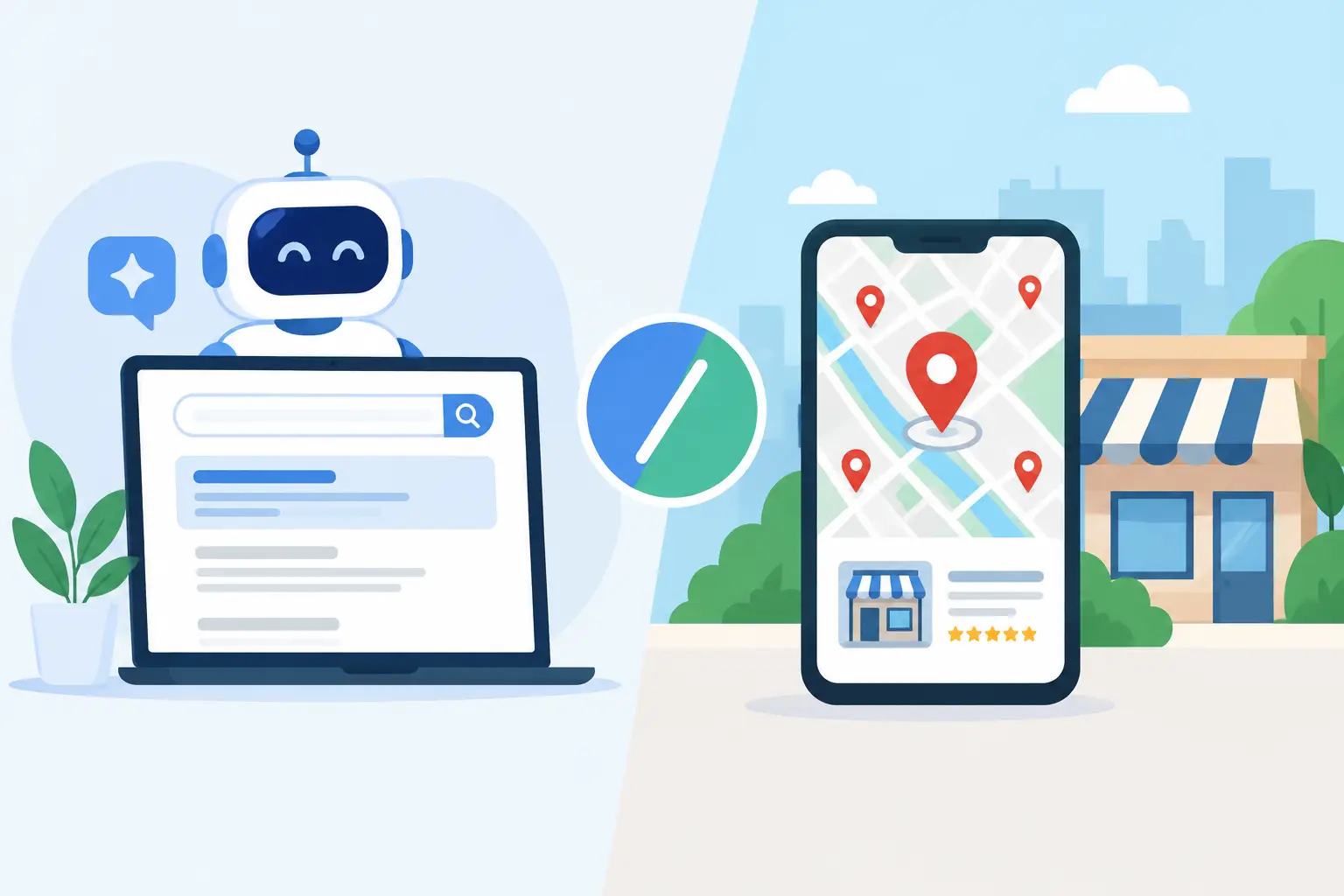
A homeowner asks an AI assistant, “What is the best emergency plumber near me?” A Google Maps user searches “plumber open now.” Those are not the same search, and treating them the same is how local businesses leave leads on the table. AEO versus local SEO is not a battle for one marketing budget. It is a decision about how your business shows up when prospects want an immediate answer, a nearby provider, or both.
If your agency is still sending a monthly ranking report without explaining calls, form fills, booked jobs, and where those leads came from, you have a reporting problem disguised as a marketing plan. Here is what each discipline does, where they overlap, and how to spend without funding another vague “visibility” campaign.
What Local SEO Is Built to Win
Local SEO helps your company appear when a buyer searches for a service in a specific area. The obvious prize is the Google Map Pack, but local visibility also includes localized organic results, driving-direction requests, calls from your business profile, and branded searches that confirm you are legitimate.
For a roofing company, that could mean ranking for “roof repair in Plano.” For a law firm, it could mean appearing for “car accident lawyer near me.” The prospect has declared a geographic need and is actively comparing providers. That is bottom-of-funnel demand when the search is handled correctly.
The foundation is not mysterious. Your Google Business Profile must be accurate, active, and matched to what you actually sell. Your site needs clear service and location pages. Your name, address, phone number, categories, reviews, and business details need to stay consistent across the web. You also need proof that real people in your market trust you.
Local SEO takes work because Google is trying to avoid sending users to the wrong business. It evaluates relevance, distance, prominence, and a long list of supporting signals. A great website alone will not rescue a weak business profile. A pile of directory listings alone will not outrank a competitor with stronger reviews, better service pages, and real local authority.
What AEO Is Built to Win
Answer engine optimization, or AEO, helps search engines and AI-driven answer systems understand your business well enough to use it in a direct response. Instead of presenting ten blue links, these systems may summarize options, recommend providers, answer a question, or cite sources.
That changes the job. You are no longer optimizing only for a ranking position. You are optimizing to become the clear, credible answer.
AEO content addresses the questions prospects ask before they are ready to search a map: “How much does water damage restoration cost?” “Can a dentist treat a cracked crown the same day?” “What should I do after a commercial truck accident?” Strong answers are specific, structured, factually supported, and connected to a real business entity.
For local service companies, AEO also includes voice-search readiness, entity consistency, topical authority, and content that gives answer engines a reason to mention you instead of recycling generic advice from a national publisher. If your site says only “we provide quality service,” there is nothing useful for an answer engine to extract. That copy is filler. It does not earn trust, citations, or leads.
AEO Versus Local SEO Is Not an Either-Or Decision
Local SEO captures the person who already knows what they need and wants a provider nearby. AEO influences the person who needs guidance, reassurance, pricing context, or a recommendation before choosing a provider. One is often location-first. The other is often answer-first.
The overlap matters. A prospective patient might ask an AI tool, “Who offers same-day dental implants in Phoenix?” That is an answer query with local intent. An answer engine needs reliable information about services, geography, reputation, credentials, availability, and the business behind the claim. Local SEO assets supply much of that evidence.
The opposite is also true. Better AEO can strengthen local performance by making your service pages more useful, clarifying the entities associated with your company, and answering the questions that create high-intent searches. The goal is not to collect buzzwords. The goal is to remove doubt at every point between the first question and the phone call.
There are trade-offs. A local SEO campaign can produce faster map visibility improvements for a business with an incomplete profile, weak reviews, or broken citation data. AEO usually requires deeper content, clearer subject-matter proof, and patience while search systems learn which sources they can trust. If your phones are quiet because no one can find you on Google Maps, fix that first. If you already dominate your immediate service area but lose prospects before they contact anyone, your answer visibility deserves more attention.
Where the Strategies Split
The biggest difference is the measurement model. Local SEO is relatively direct: map impressions, profile actions, calls, direction requests, local rankings, and leads attributed to organic local search. None of those metrics is perfect, but they can be connected to revenue when tracking is configured properly.
AEO is harder to measure with a single dashboard number. Answer engines may not consistently show referral data, citations can change, and results vary by question, user context, and platform. That does not make AEO unmeasurable. It means you need to track a broader set of evidence: branded search lift, qualified organic traffic, assisted conversions, answer placements, cited pages, and the lead quality tied to educational content.
The content also differs. A local landing page should establish service area relevance and make conversion easy. An AEO page should answer one meaningful question completely without burying the answer under sales language. The best local businesses build both types, then connect them logically. A page explaining mold remediation cost can lead a reader to a service page for local inspection and remediation. That is useful navigation, not a desperate pitch.
The No-Waste Priority Order
Most small and midsize businesses do not need a massive content library on day one. They need the right sequence. Throwing money at dozens of articles while your address is wrong, reviews go unanswered, and your service pages are thin is classic agency waste.
Start by making the local foundation credible. Confirm your Google Business Profile details, service categories, hours, photos, phone tracking, review process, local citations, and location-specific service pages. Then identify the questions that show up before a purchase decision. Sales calls, customer emails, estimate objections, and front-desk conversations are better sources than a random keyword spreadsheet.
Next, build answer-worthy pages around high-value questions. A personal injury firm should not chase every legal question on the internet. It should address questions that indicate a real case and a realistic fit for the firm. A landscape designer should explain project timelines, budget ranges, permitting realities, and design decisions that separate serious homeowners from window shoppers.
Finally, measure whether the work changes the pipeline. Track calls, forms, consultations, booked estimates, closed revenue where possible, and lead quality by channel. Rankings are diagnostic data. They are not payment.
What Good Execution Looks Like
A serious AEO and local SEO program is not a one-time setup. Business details change. Reviews arrive. Competitors add locations. Search results shift. AI systems update how they source and present answers. The company that checks its visibility once a quarter is handing ground to the operator who adjusts every week.
Good execution is also honest about uncertainty. No credible marketer can promise control over every AI answer or guarantee a permanent map position. Anyone selling that certainty is selling you a story. What can be controlled is the quality, accuracy, structure, authority, and local relevance of the information search systems use to evaluate your business.
That is where Mostly Marketing takes a different approach: prove targeted traffic and measurable movement first, then scale what is producing qualified demand. No bloated retainer. No pretending a pretty report pays payroll.
Your next move is simple. Search the questions your buyers ask, search your core services with your city attached, and look at what actually appears. If competitors own the map results, fix local authority. If generic sites and AI answers control the early research stage, build better answers. The business that earns trust before the call usually earns the call.
Share this article
The featured image previews automatically when this link is shared.