
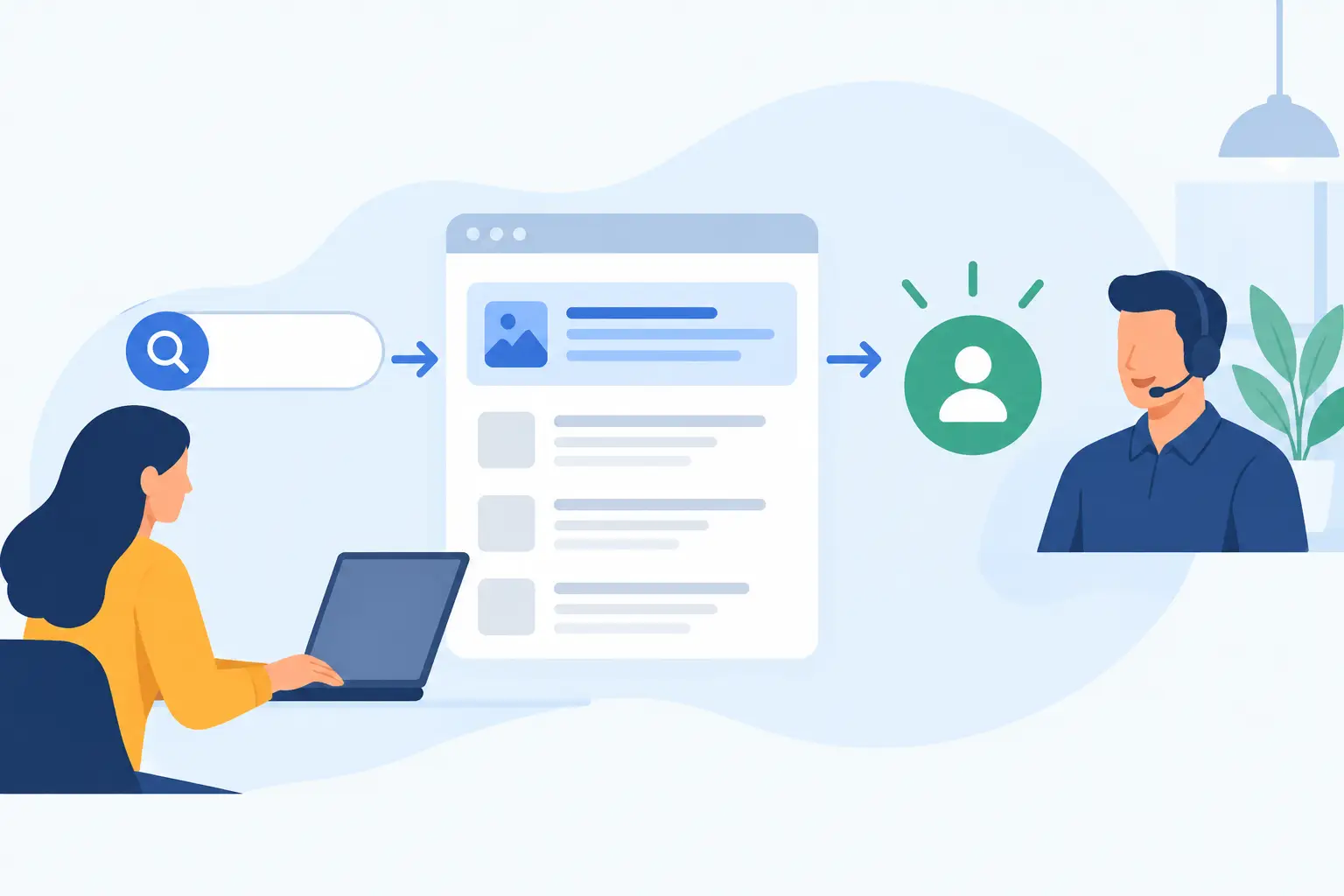
A prospect asks an AI assistant who handles emergency water damage near them, which lawyer takes truck accident cases, or which med spa offers a specific treatment. If your business is absent from the answer, your polished website traffic report will not save you. AEO results are about whether answer engines can confidently surface your business when a buyer is ready to act - and whether that visibility produces calls, forms, and booked work.
That distinction matters because plenty of agencies are selling “AI visibility” without proving commercial impact. A mention that never reaches your service area, never reflects your actual offer, and never sends a qualified lead is not a win. It is a screenshot.
What Strong AEO Results Actually Look Like
Answer engine optimization is the work of making your company easy for AI-driven search experiences to identify, understand, trust, and recommend. That includes Google’s AI-led results, voice search, map-based discovery, and platforms where people ask full questions instead of typing two-word keywords.
The goal is not to chase every answer on the internet. A local roofing company does not need to be cited for generic roofing trivia. It needs to appear when homeowners ask who can inspect storm damage in its market, what a roof replacement costs locally, or which contractor handles insurance claims.
Real AEO results show up in three layers. First, your business is accurately represented: correct services, locations, credentials, reviews, hours, and contact information. Second, it earns visibility for high-intent questions that match revenue-producing work. Third, that visibility contributes to measurable actions such as phone calls, direction requests, quote requests, consultations, and closed jobs.
The first layer is foundational. The second creates demand. The third is the only one that pays payroll.
Stop Measuring Vanity Mentions
AEO reporting gets slippery fast. There is no single universal ranking position across every AI answer, and answer engines can change their responses based on location, wording, device, and prior context. Anyone promising permanent placement in every AI response is selling certainty they cannot control.
That does not mean measurement is impossible. It means you measure like an operator, not a magician. Track a defined set of high-intent queries by service and city. Record whether your business appears, whether the details are correct, which competitors appear, and what sources are being referenced. Then compare visibility movement against qualified traffic and lead trends.
A useful scorecard includes four things:
- Presence in answers for priority commercial questions
- Accuracy of your business facts, service descriptions, and locations
- Referral, organic, map, and call activity tied to answer-led discovery
- Lead quality, booked appointments, and revenue from those inquiries
Do not hide behind impressions alone. A large number can look impressive while producing zero estimates. For a personal injury firm, one qualified case inquiry can matter more than 10,000 vague informational appearances. For a landscaper, repeated visibility for “landscape design consultation” in the right ZIP codes is more valuable than broad recognition across an entire state.
Why Most Businesses Get Weak AEO Results
The problem is usually not that a business lacks an AI tool. It lacks a credible, consistent digital footprint.
Answer engines rely on signals they can corroborate. Your website may say you are the top commercial electrician in town, but your business profile lists a different address, directories use an old phone number, review sites barely mention commercial work, and no other trusted source supports the claim. That creates friction. AI systems are built to avoid confidently recommending a business when the evidence is thin or contradictory.
Traditional agencies often worsen this by treating local SEO, content, citations, reviews, and conversion tracking as disconnected add-ons. One vendor writes blog posts. Another updates listings once a year. A third runs ads. Nobody owns the full path from entity clarity to qualified lead.
That is how businesses end up with monthly reports full of keyword movement and no clear answer to a basic question: did marketing produce more profitable work?
AEO rewards clarity. If you serve three counties, name them consistently. If you offer same-day drain cleaning but not full plumbing remodels, say so plainly. If your physicians have board certifications or your firm has specific case experience, document it where search systems and prospective clients can verify it. Vague marketing language makes weak source material.
The AEO Foundation That Holds Up
Start with the business facts that should never be in dispute. Your name, address, phone number, service areas, primary categories, operating hours, and booking path must align wherever customers and search systems encounter them. This is not glamorous work. It is also where many competitors are sloppy.
Next, build service pages around buyer questions, not generic keyword stuffing. A page for “HVAC repair” is not enough if the actual money comes from emergency repairs, heat pump replacement, commercial maintenance, or financing-qualified installs. Each major service needs clear scope, local relevance, proof, and a direct next step.
Then strengthen the evidence around your expertise. Reviews are not just reputation assets. Detailed reviews often confirm the services, places, outcomes, and customer problems associated with your business. So do accurate entity citations, local coverage, professional profiles, credentials, case examples, and consistent mentions from relevant organizations.
Finally, make conversion painless. An answer engine can send the perfect prospect, but a slow mobile site, buried phone number, confusing form, or unanswered call kills the opportunity. AEO is not separate from lead generation. It is one part of the lead-generation system.
Content should answer questions buyers actually ask
Forget publishing thirty thin articles because an SEO checklist said you need “fresh content.” That approach creates noise and burns budget.
Instead, identify questions that appear immediately before a buyer contacts a provider. A family law firm might address what happens after being served divorce papers in its state. A restoration company might explain what to do in the first hour after a flooded basement. A cosmetic practice might clarify candidacy, recovery time, and pricing factors for a treatment.
The page must be factually sound, specific, and useful without turning into a lecture. It should also make the business connection natural: who provides the service, where, under what conditions, and how a prospect can take action. This gives answer engines material they can extract and gives humans a reason to trust it.
AEO Results Depend on Your Market
Not every business should pursue the same query set or expect the same speed. A multi-location dental group has more entity signals, reviews, and content opportunities than a new independent practice. A contractor in a small market may gain meaningful visibility quickly. A law firm in a crowded metro area may need a deeper authority and review strategy before it outranks entrenched competitors.
The competitive question is not “Can we show up in AI answers?” It is “Which answers lead to the clients we want, and what evidence will make us the safest recommendation?”
This is also why broad traffic guarantees can be misleading. Traffic from the wrong geography or wrong intent is a cost center. The better standard is targeted, verified visitors and a visible path from search demand to business outcomes.
A 90-Day Plan for Better AEO Results
In the first month, audit the current footprint. Find inconsistent listings, missing categories, weak service pages, broken tracking, review gaps, and the questions competitors already own. Establish baseline visibility for priority queries and confirm that call tracking, form attribution, and CRM follow-up are working.
In the second month, fix the foundation and publish or rebuild the pages closest to revenue. Improve local entity signals, correct citations, upgrade key profiles, and create answer-ready content for the services that generate the best margins. Ask for reviews through a consistent process that respects platform rules and makes it easy for satisfied customers to respond.
In the third month, test and refine. Review which queries are producing exposure, which competitors are being referenced, and whether lead quality is improving. Expand what is working by service area or service line. Cut activities that create visibility but no commercial movement.
This is where a flexible strategy beats a bloated annual retainer. The market gives feedback. Your campaign should respond to it.
The Standard: Proof Before Scale
AEO is not a magic replacement for SEO, local visibility, reviews, or conversion work. It is the next pressure test for all of them. If search systems cannot understand and trust your business, neither can the buyer who is comparing options at 9 p.m. from a phone.
Mostly Marketing treats answer visibility as a performance channel, not a shiny new service label. The work should be visible, the reporting should be understandable, and the results should move toward revenue.
Start with the questions your best customers ask before they call. Then make sure every credible signal about your business gives the same clear answer: this company does the work, serves this area, and is worth contacting.
Share this article
The featured image previews automatically when this link is shared.